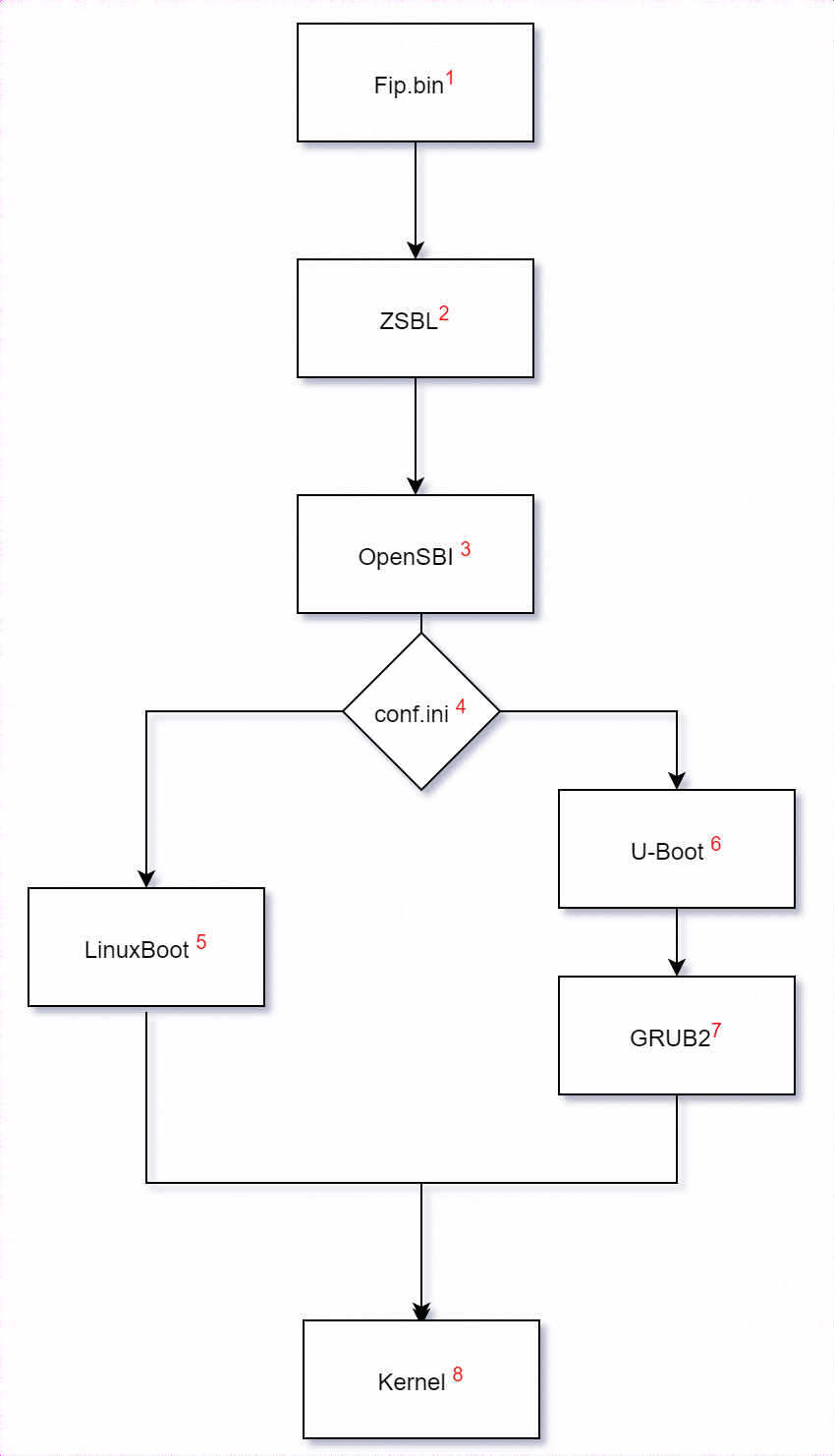
ZSBL (Zero Stage Bootloader): Code in the ROM of the board to
initial DDR, CPU and Ethernet. Then load OpneSBI and U-Boot.
OpenSBI (RISC-V Open Source Supervisor Binary Interface): The goal
of the OpenSBI project is to provide an open-source reference
implementation of the RISC-V SBI specifications for
platform-specific firmwares executing in M-mode. An OpenSBI
implementation can be easily extended by RISC-V platform and
system-on-chip vendors to fit a particular hardware configuration.
conf.ini: configuration file used to choose next bootloader.
LinuxBoot: LinuxBoot is a firmware for modern servers that replaces
specific firmware functionality like the UEFI DXE phase with a Linux
kernel and runtime.
U-Boot (Universal Bootloader): Its primary role is to facilitate the
booting process of the embedded device.
GRUB2 (GRand Unified Bootloader version 2): It is responsible for
loading and transferring control to an operating system kernel
software (such as Linux or GNU Mach). The kernel, in turn,
initializes the rest of the operating system (e.g. a GNU system).